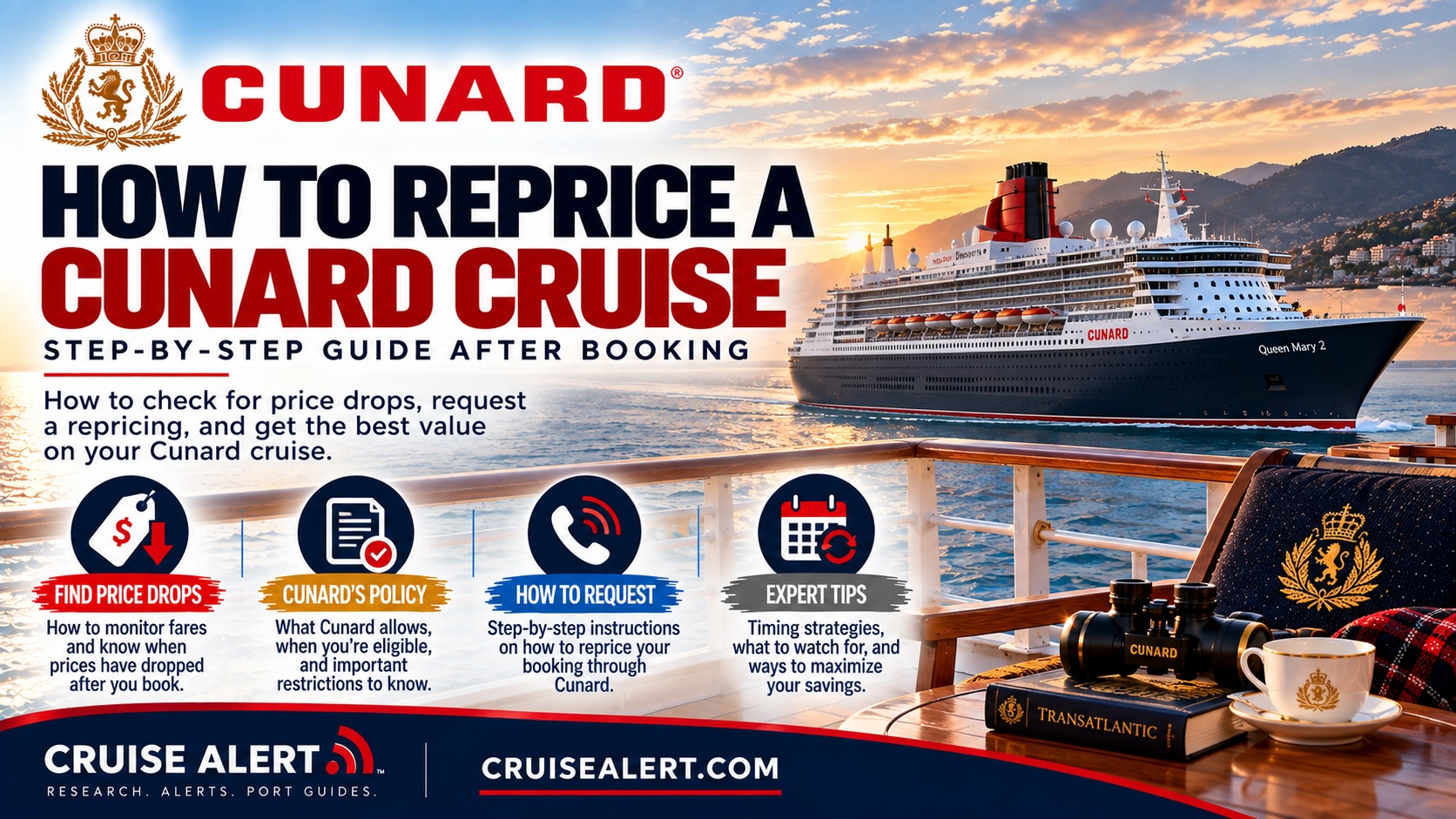
Cunard has no Best Price Guarantee (see the full Cunard price-drop guide). A courtesy repricing request is not a claim against a documented policy, it's a reasonable ask to an experienced representative that a fare adjustment serves both parties, on a voyage where conditions make that plausible.
That framing matters because it changes what success looks like and how to approach the conversation. The preparation before the call, the channel you use, and the conditions on the voyage determine whether the effort is worth making at all. On Saver fares, the effort is never worth making, the terms are absolute and no amount of requesting changes them. On Cunard Fare and Early Saver bookings, the effort is sometimes worth making when the conditions are right.
Before You Call: Confirm Two Non-Negotiable Conditions
1. Your fare type is Cunard Fare or Early Saver.
If you're on a Saver fare, stop here. Saver fares permit no amendments and carry a 100% cancellation fee from the moment of booking. No courtesy adjustment exists, no escalation path changes this, and no agent relationship produces a different outcome. Saver fare terms are absolute.
If you're on a Cunard Fare or Early Saver, proceed.
2. The lower fare is the same fare type for the same voyage and stateroom grade.
A lower Saver fare appearing on your sailing is not a basis for repricing a Cunard Fare booking. These are different products with different terms. The lower fare needs to be a Cunard Fare (if you're on a Cunard Fare) or an Early Saver (if you're on an Early Saver) for the same voyage and stateroom grade to provide a reasonable basis for the request.
Conditions That Predict Success
Courtesy repricing requests on Cunard succeed most consistently when all of the following are true:
The fare gap is meaningful. Under $75 per person, the effort rarely produces results. Above $150 per person, the request is clearly worth making. Above $200 per person, it's worth significant effort including escalation if the first call doesn't produce results.
The voyage has available inventory. Cunard's motivation to adjust a committed booking is directly tied to whether they still need to sell the voyage. Check cunard.com for your voyage, if the stateroom category is showing available inventory, Cunard has more reason to work with you. On near-full sailings, the calculus is different.
You're before final payment, in the 6-to-10-week window. The pre-final-payment period is the most productive window for these requests. Earlier requests on voyages with long lead times produce less consistent results. After final payment, courtesy adjustments on Cunard are rare.
The request routes through an experienced Cunard-specialist agent. This is the single most reliable predictor of a positive outcome. A UK-based Cunard specialist who books significant Cunard volume has a trade relationship with Cunard that produces materially better outcomes than a direct consumer call. For US passengers working through a US-based agent, verify the agent has active Cunard booking history before routing the request.
World Club status. Gold, Platinum, and Diamond members should mention their status on the call, it provides relationship context that sometimes shifts the conversation.
Track your Cunard fare and get an alert the moment it drops — CruiseAlert.com
Step 1: Document the Lower Fare
Go to cunard.com. Search your exact voyage, same ship, same departure date. Navigate to the stateroom category you booked. Find the current fare for the same fare type as your booking.
Screenshot the page showing: the fare amount per person, voyage details, stateroom category, fare type designation, and the date of capture. Cunard's pricing can adjust; documentation protects your position if the fare moves between when you find it and when Cunard reviews your request.
Step 2: Calculate Whether the Request Is Worth Making
Gross gap = (your current fare − lower current fare) × number of guests
Then factor in any promotional benefits you'd lose if the repricing applies the new fare's terms to your booking. If your current booking carries onboard credit or other benefits and the lower fare doesn't, subtract that value from the gross gap.
If the net gap is meaningful and positive, proceed.
Step 3: Contact the Right Channel
Booked through a Cunard-specialist travel agent: contact your agent first and ask them to request a courtesy fare adjustment, providing documentation of the lower fare. An agent with established Cunard volume and trade relationships produces better outcomes than any other channel.
Booked directly with Cunard: call Cunard's reservations line and ask specifically for a fare adjustment on your booking, referencing the lower available fare for the same voyage, fare type, and stateroom grade. State your World Club number upfront. Be specific: "I'm calling because the same [fare type] for my voyage is currently showing at [lower fare], that's [dollar gap] per person less than what I paid. I'd like to ask whether a courtesy adjustment is available."
If the first representative says no: call back. Cunard's call center consistency on these requests varies. A call that produces no on one day sometimes produces yes on another day with a different representative, particularly if the voyage still has available inventory.
Step 4: The Cancel-and-Rebook Alternative
When courtesy repricing fails and the gap is large enough, cancel-and-rebook is the alternative path on Cunard Fare bookings. The economics:
Net savings = (current fare − lower fare) × guests − cancellation fee
Cunard's cancellation fee schedule for standard staterooms (non-Grill) is broadly:
More than 91 days before sailing: deposit only forfeited
90–57 days: 50% of fare
56–29 days: 75% of fare
28 days or fewer: 100%
For Grill suite bookings, penalties onset earlier, check the specific cancellation schedule for your voyage and stateroom category.
The cancel-and-rebook path is most viable when the voyage is more than 91 days out and the net savings clearly exceed the deposit forfeiture. Closer to sailing, the escalating penalty schedule typically eliminates the economic benefit.
The Saver complication in reverse: if the lower fare you want to rebook at is a Saver fare, you're trading Cunard Fare flexibility for Saver non-refundability on the new booking. This is a specific risk to assess honestly, you're giving up the ability to change or cancel the new booking in exchange for the savings. If your plans carry any uncertainty, the Cunard Fare on a new booking at the lower fare is better than a Saver even if the entry price is marginally higher.
What We've Seen In Practice
The channel is the most decisive variable, not the fare gap, not the voyage demand profile. Requests routed through experienced Cunard-specialist agents succeed at meaningfully higher rates than direct consumer calls on comparable fare gaps and voyage conditions.
The World Club status mention matters more on Cunard than on some other lines because Cunard's passenger base is more loyalty-oriented. A Diamond or Platinum World Club member asking for a courtesy adjustment has a different standing in the conversation than a first-time Cunard passenger making the same request. It doesn't guarantee a yes, but it changes the nature of the ask.
QM2 transatlantic crossings are the hardest voyages on which to obtain courtesy adjustments, demand is strongest, pricing holds most firmly, and Cunard has the least motivation to adjust committed bookings. Caribbean sailings on Queen Elizabeth and Queen Victoria in shoulder season are the most productive profile for courtesy requests.
The most preventable failure: direct consumer calls with no documentation of the lower fare. A Cunard representative who can't verify the lower fare in the booking system quickly needs documentation to support the request. Calling with a screenshot showing the fare, date, voyage details, and fare type takes the ambiguity out of the conversation.
Common Questions
Is it worth calling Cunard directly or should I always use an agent?
For UK passengers with an established Cunard-specialist agent relationship, route through the agent every time. For US passengers who booked direct, calling Cunard is reasonable, but verify whether the representative you reach has familiarity with courtesy fare adjustments, and be prepared to ask for a supervisor or specialist if the first contact says it isn't possible without explaining why.
How many times can I request a courtesy adjustment on the same booking?
No documented limit, but persistent requests on the same booking after clear denials are unlikely to produce different outcomes unless conditions change, a further fare drop, different remaining inventory, or different representative.
The lower fare disappeared before Cunard reviewed my request. What happens?
Your documentation (a timestamped screenshot of the lower fare when it existed) is your evidence. A well-documented request with evidence the lower fare existed is more likely to be honored than one without documentation, even if the fare has since recovered.
I'm on an Early Saver and the Cunard Fare on my voyage has dropped below my Early Saver price. Does that support a request?
The comparison for a courtesy request needs to be same-fare-type (Early Saver to Early Saver, Cunard Fare to Cunard Fare. A Cunard Fare dropping below your Early Saver price is a different product comparison. Contact Cunard to ask how they handle this specific scenario) some agents have successfully navigated Early Saver-to-Cunard-Fare parity arguments, but it's not a standard basis for a repricing request.
I'm a Platinum World Club member. Does that give me a stronger case?
It shifts the conversation rather than guaranteeing an outcome. Platinum members have demonstrated 15+ voyage loyalty. Mentioning this specifically on the call ("I'm a Platinum World Club member and I've sailed Cunard [X] times") is the right framing. It's not a policy entitlement but it's real relationship context.